

Images through
human eyes
What if you could search for images by how they make you feel, not by what they show? PsyObjects maps the invisible — the gut reactions, the instinctive words — that connect humans to images.
No credit card required · Free plan available

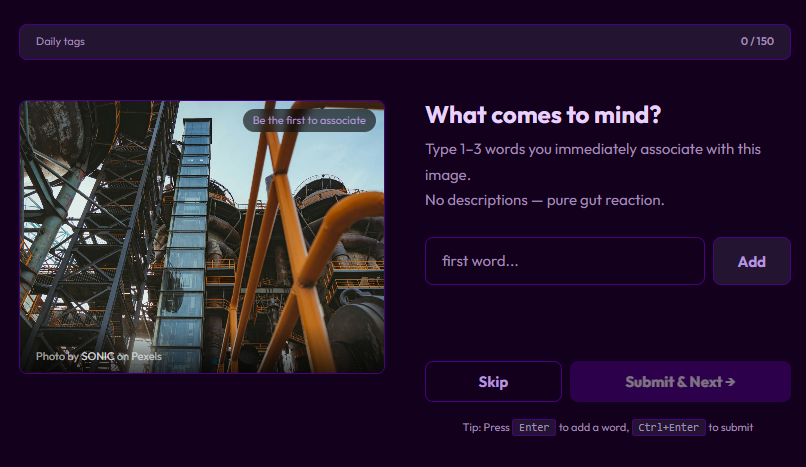
Tag images & earn tokens
Every day a fresh set of images is waiting. You see one — and you type the first word that comes to mind. No descriptions, no labels. Just raw, instinctive association.
Your reactions become data points in a growing map of human perception. And every tag you submit earns you credits — redeemable to explore what others have associated with any image in the collection.
- Up to 30 free tags per day
- Earn credits for every contribution
- Pure gut reaction — 1 to 3 words per image
- New images added continuously
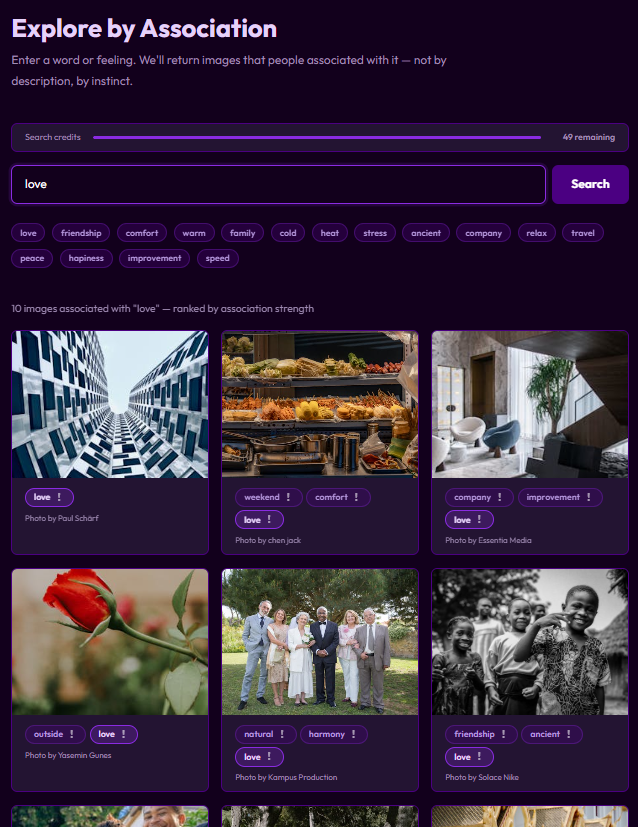
Explore already-tagged images
Type a word — melancholy, power, childhood — and see every image that people instinctively associated with it. Not by metadata. Not by AI description. By human instinct.
The result is a visual landscape of shared human perception — a database built entirely from gut reactions, searchable by feeling.
- Search by emotion, sensation, or concept
- Results ranked by association strength
- See the words others gave each image
- Use credits to unlock deeper results
How it works
Three simple steps, one growing map of human perception
See an image
A photograph appears — taken from a curated collection of diverse, evocative images. No context, no title.
React instinctively
Type the first 1–3 words that come to mind. Not what you see — what you feel. Speed matters. Your gut reaction is the data.
Explore & discover
Use your earned credits to search the database. Find images by emotion, sensation, or instinct — results shaped by real human responses.
Earn your place in the community
Every tag you submit counts. Reach milestones and collect badges that mark your journey.
Badges appear on your account and next to your name throughout the platform. Start contributing to earn your first one.
Questions & background
The psychology, the principles, and the practical details
What is psychological association?
Associative thinking is one of the brain's most fundamental processes. When we encounter a stimulus — an image, a sound, a smell — our minds immediately and involuntarily link it to stored concepts, emotions, and memories. This is the basis of associationism, a theory with roots in Aristotle and developed extensively by philosophers Locke, Hume, and later psychologists including Freud and Jung.
PsyObjects captures this process at scale: when thousands of people independently associate the same word with the same image, that association becomes statistically meaningful — a window into shared human perception.
Why gut reactions, not descriptions?
Deliberate description engages the prefrontal cortex — the analytical, language-processing brain. It produces accurate labels but filters out emotional content. Gut reactions, by contrast, draw on the limbic system: faster, more emotional, and closer to how images are actually experienced.
Research in affective psychology suggests that emotional responses to images show meaningful consistency across individuals and cultures. Russell's circumplex model of affect (1980) and Osgood's semantic differential work (1957) both point to the existence of shared dimensional structures in how humans evaluate stimuli — dimensions like valence and arousal that transcend personal history. PsyObjects is built on this consistency.
What can the data be used for?
The association database has potential applications across multiple fields: visual communication research, advertising effectiveness studies, cross-cultural perception analysis, UX and product design testing, and art therapy research. It also has practical creative uses — finding images that evoke a specific emotional tone without keyword limitations.
How is my data handled?
The words you submit are stored anonymously and aggregated with responses from other users. No individual response is ever published or linked to your account. We comply fully with GDPR and do not sell personal data. See our Privacy Policy for full details.
Is there a free plan?
Yes. Free accounts can tag up to 30 images per day and receive daily search credits for every contribution. Paid plans (PremiOm and PrO) unlock higher limits, more search results, and additional features. See our Pricing page.
What is the credit system?
Every tag you submit earns credits. Credits are used to search and explore the image database. This creates a contribution loop: the more you give to the collective dataset, the more you can explore it. Paid plans receive additional daily credit allocations on top of earned credits.
Ready to see images differently?
Join a growing community mapping human perception — one gut reaction at a time.